


Edited by Agapito Emanuele Santangelo - Data analysis strategist; Giulia Marucci - Master's student in Management and Business Consulting
In Italy, on 28 September the average price of a 50-litre fill-up was 40 cents lower than the previous day. Almost all of the drop came from Agip Eni stations, which went from 2.151 to 2.110 €/l (−4.1 cents) with the introduction of the 1.99 €/l price cap. To obtain information this timely and precise, the Instant Analytics team extracted provincial fuel price data, making it possible to monitor these changes.
In economics, fuel is the textbook case of negative externalities: those who consume it shift the costs of pollution and congestion onto everyone else, and excise duties exist, in theory, to make those who generate these costs pay for them. 2026 turned this mechanism upside down. The war in Iran, which began on 28 February with the attack by the United States and Israel, and the closure of the Strait of Hormuz announced by Tehran on the evening of 1 March pushed the price of a barrel above 100 dollars and Italian diesel above its 2022 records: a price rise that originates outside the Italian market and in turn behaves like a negative externality, a cost imposed on households through transport and the prices of goods.
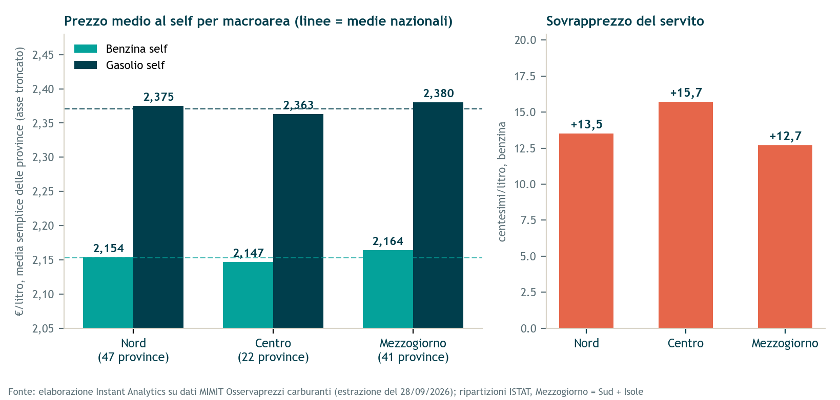
What is almost always missing from the debate is the starting point: how much a fill-up costs province by province and where it weighs most. Instant Analytics has built a dashboard that calculates this every morning from the prices that station operators report to the MIMIT Fuel Price Observatory (Osservaprezzi). The snapshot of 28 September, taken at 8 a.m., one hour after the Eni and Ip price caps came into force, shows a 10.3 cents per litre gap in petrol prices between the cheapest and the most expensive province, and a South that pays 1.7 cents more than the Centre. Attended service costs on average 13.8 cents more than self-service at the same station.
The dashboard captures the current situation, but this needs a historical perspective to track changes. Compared with a year ago, on 28 September 2025, self-service petrol and diesel cost on average 26% and 44% less respectively. Compared with 27 February 2026, the last day before the attack on Iran, petrol has risen by 48 cents per litre and diesel by 65. As shown in Figure 1, prices have fluctuated considerably, but in September they reached their highest levels since July 2025.
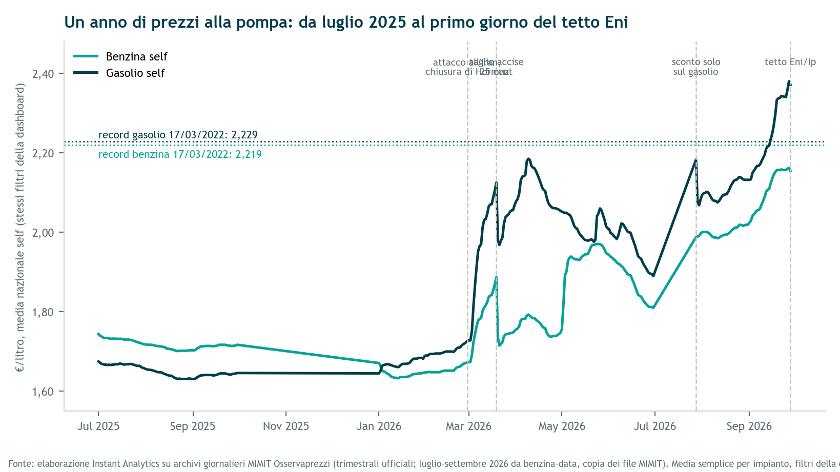
Every morning the dashboard reads the prices charged at 8 a.m. by active stations, using a web scraping algorithm. This methodology makes it possible to retrieve data from online sources (websites, social media, blogs and other web sources) and process it in real time. In this case, the tool makes it possible to know the average prices charged in Italy (the extraction of 28 September 2026 contains 92,803 price reports from 23,775 stations) and to calculate national averages (2.154 euros/l for self-service petrol, 2.371 euros/l for diesel). However, its real potential lies in the territorial breakdown of the data, which allows us to see fuel costs by province and highlight price differences.
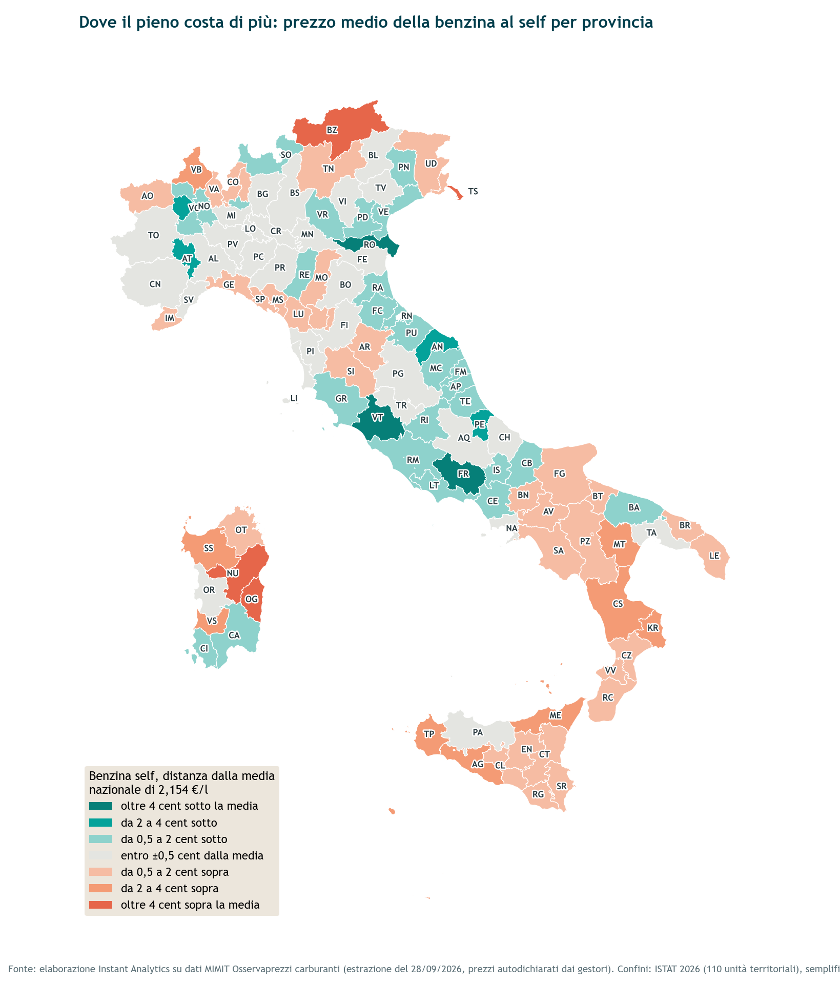
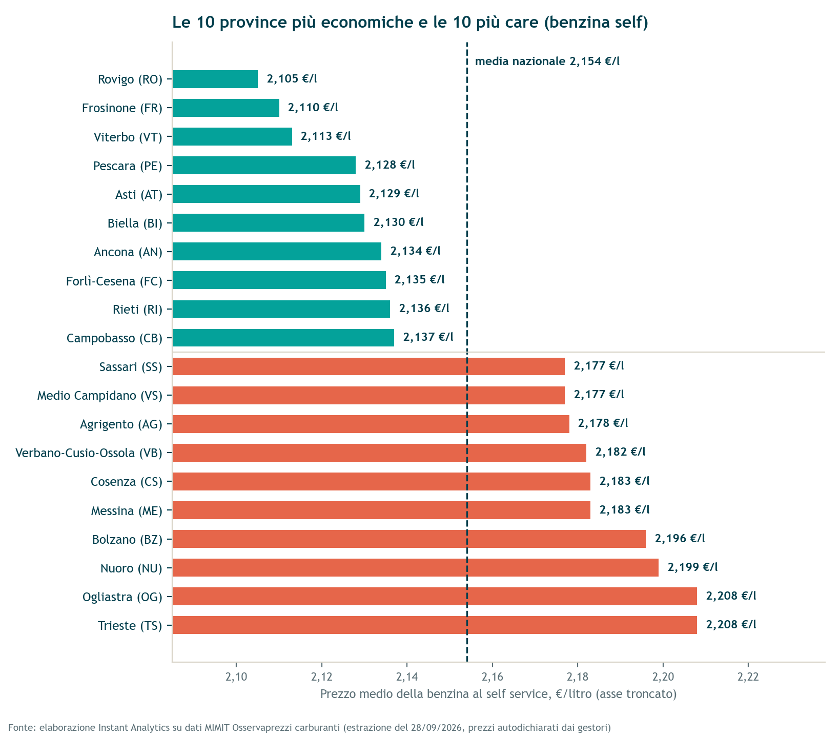
Province by province (Figure 2), there is no North-South divide: although there are differences between macro-areas, they are limited. For self-service petrol, the Centre is the cheapest area (2.147 €/l, average of 22 provinces), the North has an average price of 2.154 €/l (47 provinces) and the South 2.164 €/l (41 provinces): 1.7 cents per litre more than the Centre and 1 cent per litre more than the North. For diesel the picture is the same: 2.363 €/l in the Centre, 2.375 €/l in the North, 2.380 €/l in the South (Figure 3). Beyond the average prices by macro-area, it is important to see how values vary within them. The most expensive provinces are Trieste, Ogliastra, Nuoro, Bolzano and Messina, i.e. the north-eastern border and the islands; the cheapest are Rovigo, Frosinone, Viterbo, Pescara and Asti (Figure 4).
The dashboard figures give motorists a picture of the whole country: the most effective lever remains the way they refuel, even before the choice of filling station.
Federconsumatori estimates that, in addition to direct costs, households have faced around 224 euros in indirect costs since the start of the conflict. It is a negative externality, measured in euros. Cutting excise duties to cushion it is an understandable choice in an emergency, but it suspends the very tool that should internalise the costs of consumption.
The dashboard is regenerated every day with the same procedure and the same filters. In the coming weeks we will measure, province by province, how much of the Eni and Ip price cap reaches the pump and how much passes on to unbranded stations and other brands, and what will happen to diesel from 6 October, when the excise discount is expected to give way to the variable excise duty. Explore the full dashboard here.
Sources
MIMIT, Osservaprezzi fuel prices, open data on prices charged and station registry (extractions of 27 and 28 September 2026); MIMIT, historical archive of prices charged and station registry (quarters 2022-1, 2025-3, 2026-1, 2026-2); daily copies of MIMIT files for July-September 2026; ISTAT, boundaries of territorial units as at 1 January 2026 (CC BY 4.0); Ministry of the Environment and Energy Security, weekly price survey (January-August 2026).
Notes
Since prices are self-reported, the procedure applies some filters before calculating averages. It keeps only petrol and diesel; it discards reports older than seven days and values outside a plausible range (1.20-3.00 euros per litre: the open data contain typos ranging from 0.01 to 8.90 euros); and it excludes stations in Livigno, a duty-free zone where fuel is not subject to excise duties. Without this last filter, Sondrio would be the cheapest province in Italy, while with the filter it drops to eighteenth place (2.142 euros): a tax artefact, not a market price, to bear in mind when reading daily rankings that do not declare territorial exclusions. This leaves 66,658 reports from 20,854 stations.
Instant Analytics Srl – Data for People
Accredited spin-off of the University of Molise
Via Francesco De Sanctis, Snc - Campobasso
VAT 01949560708
info@instantanalytics.it
Privacy Policy